AI Orchestration: The Beating Heart of Your AEP
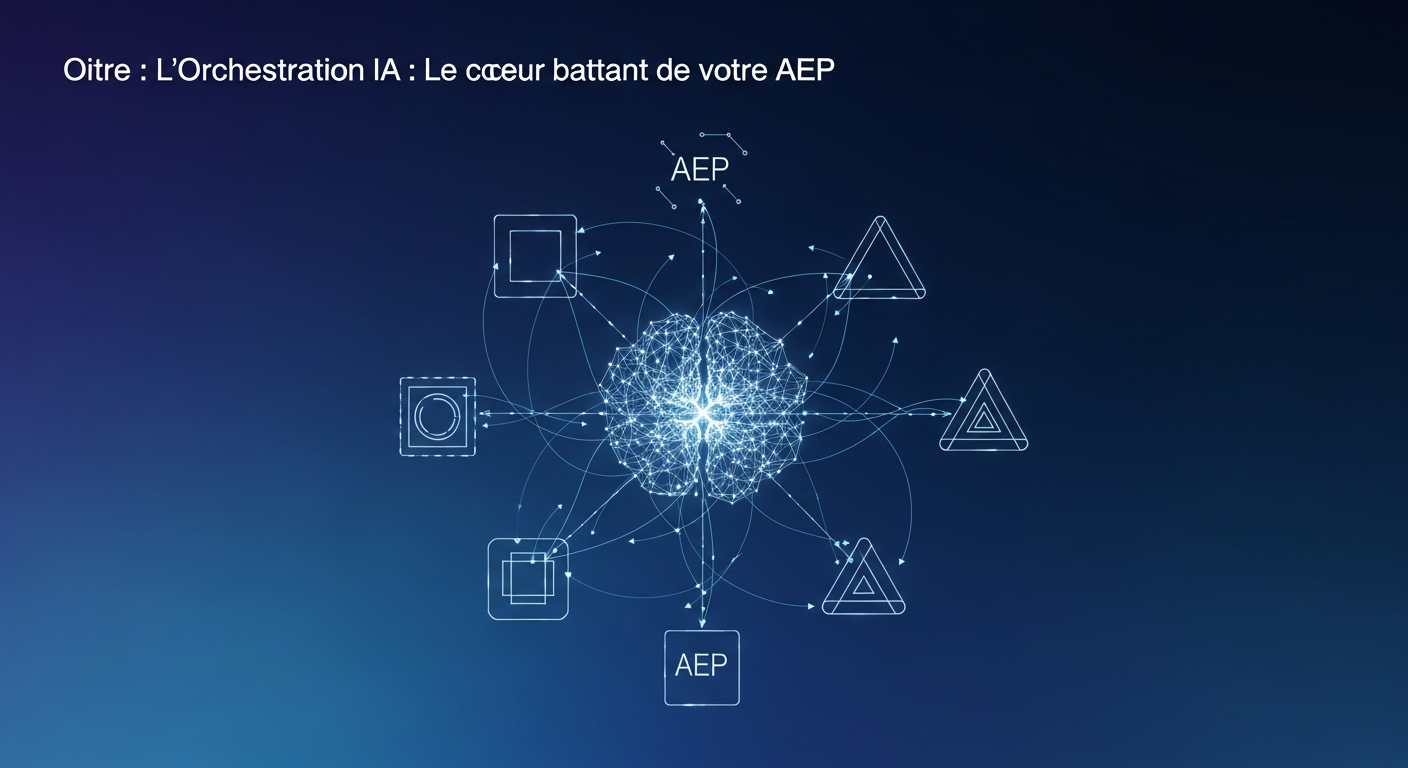
Many people confuse “Automation” with “Orchestration.” It’s like confusing a nerve reflex with a brain.
Automation (Zapier, Make) is linear: “If X happens, do Y.” It’s dumb and blunt. If the condition changes, everything breaks.
Orchestration is biological. It’s the higher level we use in an AEP (Architectural Economic Platform).
Why Automation Is No Longer Enough
Classic automation has its limits: it doesn’t know how to adapt. If you automate a tweet every day at 9am, the robot will do it even if a global catastrophe just happened, making you look like an insensitive idiot.
Orchestration adds a layer of intelligence (AI) in the middle of the process.
It’s the difference between a thermostat (automation) and a smart climate system that anticipates your habits, detects your presence, and adjusts temperature based on the weather outside (orchestration).
In the pre-AI world, automation was enough. In the New Economy, it has become a weakness. A rigid system is a fragile system.
The AEP Orchestrator Schema
In FlowContent, orchestration works according to a permanent feedback loop:
1. The Observer Agent (Input)
It doesn’t just wait for a trigger. It “watches” the context constantly:
- Google and social media trends
- News in your niche
- Competitor behavior
- Weak market signals
It’s your lookout in the control tower.
2. The Decision Agent (Brain)
This is the heart of orchestration. It receives the info and decides if it’s relevant to act.
It can say:
- “No, no tweet today, the market is saturated.”
- “Alert: Opportunity detected, launch the protocol.”
- “This trend has been rising for 48h, prepare an in-depth article.”
The Decision Agent is what transforms your AEP from a stupid machine into a quasi-conscious system.
3. The Executor Agent (Output)
It performs the action (write, publish, sell) only if the Decision Agent has validated.
And most importantly, it reports results back to the Observer Agent, thus creating a continuous learning loop.
The Difference from Classic Prompt Engineering
Prompt Engineering as it’s taught is talking to an AI to get a one-time response. It’s transactional.
Orchestration is creating an ecosystem of agents that communicate with each other, learn from each other, and make collective decisions.
Imagine the difference:
- Classic prompt: “Write me an article about luxury watches.”
- Orchestration: The Watch Agent detects Rolex just announced a new model → The Analysis Agent evaluates SEO potential → The Decision Agent validates relevance for your niche → The Writing Agent produces the article → The Publication Agent distributes it at the optimal time → The Analytics Agent measures results → The cycle starts again.
Do you see the difference in power?
Becoming the Conductor
Your role as an Economic Architect is not to play instruments. It’s to define the score.
When you configure your AEP, you’re not creating “Zaps.” You’re recruiting virtual agents and giving them a mission.
- “Watch Agent: Report everything that comes out about luxury real estate.”
- “Writing Agent: If the Watch Agent finds an opportunity, write a LinkedIn summary.”
- “SEO Agent: Analyze the competition and suggest differentiating angles.”
- “Monetization Agent: Identify relevant affiliate products to integrate.”
Orchestration as Competitive Advantage
In a world where everyone has access to ChatGPT, the difference is no longer in access to AI. It’s in the quality of orchestration.
Two Architects with the same tools will produce radically different results depending on their mastery of orchestration.
It’s this Orchestration layer that makes your AES (Autonomous Economic System) alive, resilient, and almost human in its interactions.
It’s also what makes you irreplaceable. AI can execute. It cannot yet orchestrate with strategic vision.
Your value is in the score, not in the notes.