The Art of Direction: Why AI Won't Kill Artists, But Executors
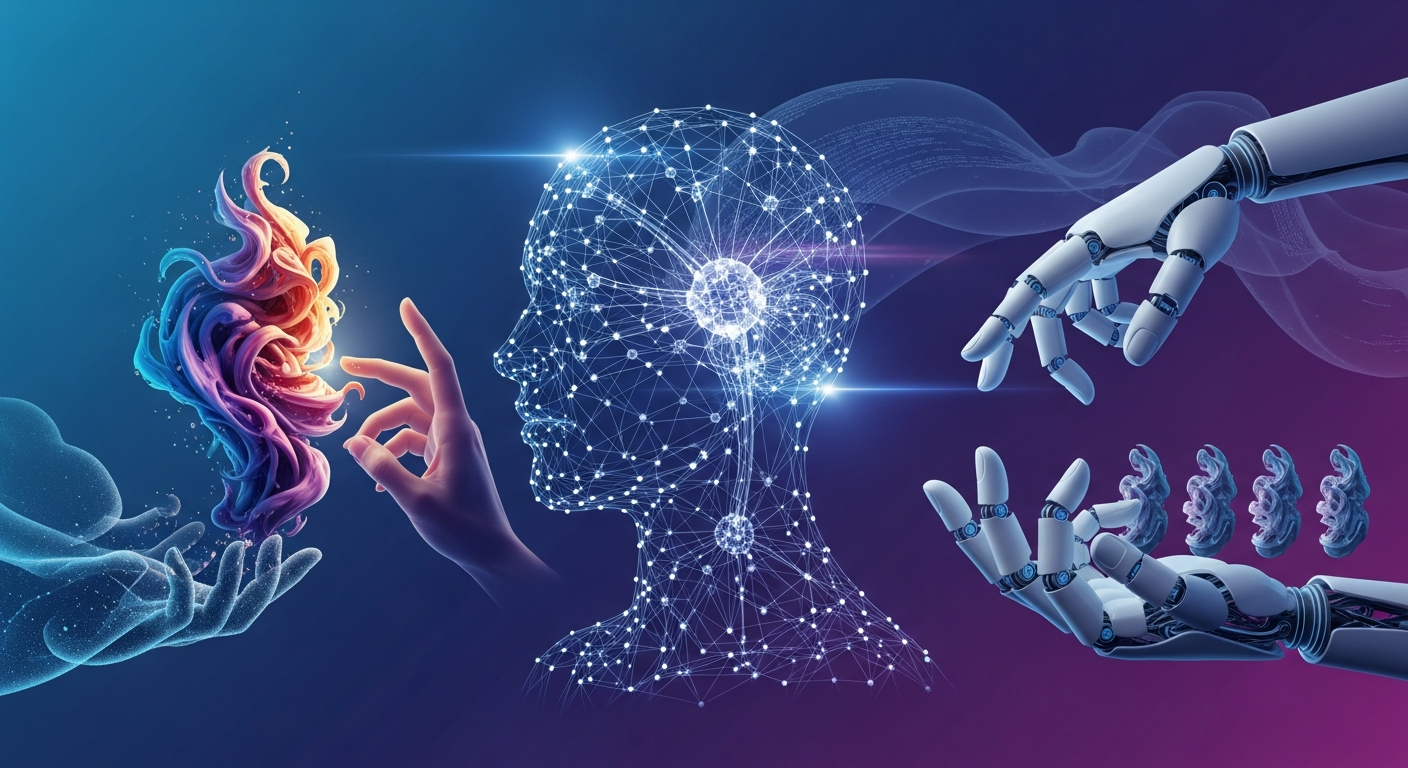
There’s panic among creatives.
Graphic designers, writers, illustrators, photographers are crying foul:
“AI is stealing our art!” “It’s the end of human creativity!” “We’ll all be replaced!”
They’re fighting the wrong battle.
AI doesn’t kill Art. It kills technical Craftsmanship.
It kills the need to spend 10 years learning to hold a brush. It kills the need to master Photoshop for thousands of hours. It kills the need to code to create a website.
But it doesn’t replace — and never will — the necessity of having a Vision.
The Confusion Between Art and Craftsmanship
What Craftsmanship Is
Craftsmanship is the technical mastery of a medium.
- Knowing how to draw a realistic hand
- Knowing how to conjugate tenses in English
- Knowing how to use layers in Photoshop
- Knowing how to code a CSS animation
Craftsmanship can be learned. It requires years of practice. It can be measured objectively.
And it can be automated.
What Art Is
Art is the vision that guides craftsmanship.
- Deciding WHAT to draw and WHY
- Choosing the TONE and EMOTION to convey
- Designing the overall EXPERIENCE
- Creating MEANING from chaos
Art can’t really be learned. It emerges from culture, experience, an individual’s unique sensitivity.
And it CAN’T be automated.
The Fatal Confusion
Many “creatives” are actually technical craftsmen who think they’re artists.
They master Photoshop. They know how to retouch a photo. They can reproduce a style.
But they have no vision of their own. They execute others’ visions.
They’re the ones AI replaces. Not the true artists.
From Craftsman to Film Director
Think of Steven Spielberg.
What Spielberg Does NOT Do
- He doesn’t hold the camera
- He doesn’t sew the costumes
- He doesn’t compose the music
- He doesn’t build the sets
- He doesn’t do the editing frame by frame
- He doesn’t adjust the lights
What Spielberg DOES
- He has the vision of the film
- He decides the emotion of each scene
- He directs actors toward his vision
- He validates or rejects each element
- He maintains the whole’s coherence
- He carries the final artistic responsibility
Yet, it’s his film. It’s his art. His name is on the poster.
Why? Because he’s the Director. He orchestrates others’ talents to serve his unique vision.
The Architect as Director
The Economic Architect is the Spielberg of his business.
AI is his technical team:
- His cameraman (Visual Agent)
- His screenwriter (Writing Agent)
- His editor (Publication Agent)
- His marketing director (Acquisition Agent)
The Architect doesn’t do the technical work. He directs technical work toward his vision.
The Renaissance of “True” Creativity
Until now, creativity was constrained by technique.
The Technical Wall
You had a brilliant idea for a website, but you didn’t know how to code. → Dead idea.
You had a vision of an image in your head, but you didn’t know how to draw. → Dead idea.
You wanted to write a book, but you were afraid of the blank page. → Dead idea.
You dreamed of a business, but you didn’t master marketing. → Dead idea.
How many creative geniuses never got to express themselves because they didn’t have the technique?
The Wall Crumbles
The AEP (Architectural Economic Platform) removes the technical barrier.
The distance between your Brain (the Idea) and the Screen (Reality) is reduced to near-zero.
- You describe the site → AI codes it
- You describe the image → AI generates it
- You describe the content → AI writes it
- You describe the strategy → AI executes it
What took months takes hours. What cost thousands of dollars costs cents. What required 10 years of learning requires 10 minutes of explanation.
The Democratization of Creation
For the first time in history:
- The dyslexic can publish bestsellers
- The untrained architect can design virtual buildings
- The entrepreneur without a team can launch media empires
- The visionary without capital can compete with multinationals
Tomorrow’s creativity is no longer “How do I do it?” It’s “What do I want to see exist?”
The Prompt is an Act of Creation
Some will say: “But typing a prompt isn’t art!”
They deeply underestimate what a good prompt is.
The Prompt as Score
A prompt isn’t a command. It’s a score.
Like a musical score guides an orchestra toward a work, the prompt guides AI toward a creation.
A bad conductor with a good score = mediocre result. A good conductor with a good score = masterpiece.
What an Excellent Prompt Requires
Culture You must know the references. “In the style of Wes Anderson” only works if you know who Wes Anderson is and what characterizes his style.
Precision You must know exactly what you want. Details matter. The mood. The lighting. The tone. The structure.
Iteration You must know how to refine. The first result is rarely perfect. The art is in successive adjustments.
Judgment You must know when it’s good. When it’s almost good. When it’s bad. And why.
The Art of Prompting
Knowing how to talk to the machine to get exactly what you have in mind is a superior art.
It’s the art of linguistic precision. It’s the art of visual and narrative culture. It’s the art of nuance and detail.
A good “prompt artist” is rarer than a good Photoshop technician.
The New Creative Professions
AI doesn’t destroy creative professions. It transforms them.
Declining Professions
- Basic photo retoucher
- Generic web writer
- Execution graphic designer
- Standard text translator
- Template website developer
Booming Professions
- AI Art Director: The one who guides visual AIs toward a coherent vision
- Creative Prompt Engineer: The one who knows how to extract the exceptional from AIs
- AI Content Curator: The one who selects and refines outputs
- Experience Architect: The one who designs user journeys
- Narrative Strategist: The one who defines the vision and message
The Common Thread
All these professions are direction jobs, not execution jobs.
They require vision, judgment, culture. Not technical dexterity.
The New Creative Power
Before AI, creative power belonged to those who mastered technique.
Design studios. Ad agencies. Publishers. Production houses.
They had the tools, skills, teams.
The Power Transfer
With AI, creative power transfers to those who have the vision.
A single individual with a clear vision can now produce what required 50-person teams.
Barriers to entry collapse. Gatekeepers lose their power. Visionaries can finally create.
The Golden Age of Individual Creativity
We’re potentially entering a golden age.
More diverse visions can be expressed. More unique voices can emerge. More experimentation is possible.
The only limit now is imagination.
Don’t Mourn the End of the Brush
Craftsmen mourning AI’s arrival are like copyist monks mourning the printing press.
“How will they dare reproduce sacred texts without spending years calligraphing them?”
The printing press didn’t kill literature. It democratized it. It allowed more voices to be expressed. It created the Renaissance.
AI won’t kill art. It will democratize it. It will allow more visions to take shape. It will create a new Renaissance.
Celebrate the Magic Wand
Don’t mourn the end of the brush. Celebrate the arrival of the magic wand.
AI doesn’t replace you. It gives you the giant hands you’ve always dreamed of.
You can now:
- Create at the speed of your thought
- Experiment without cost
- Iterate without limit
- Manifest your pure vision
The only prerequisite: having a vision.
If you don’t have a vision, AI won’t save you. If you have a vision, AI will make it real.
The future belongs to Directors, not Executors.
Become the director of your empire. AI will be your production team.