ClickFunnels vs AEP: Why Classic Sales Funnels Are No Longer Enough
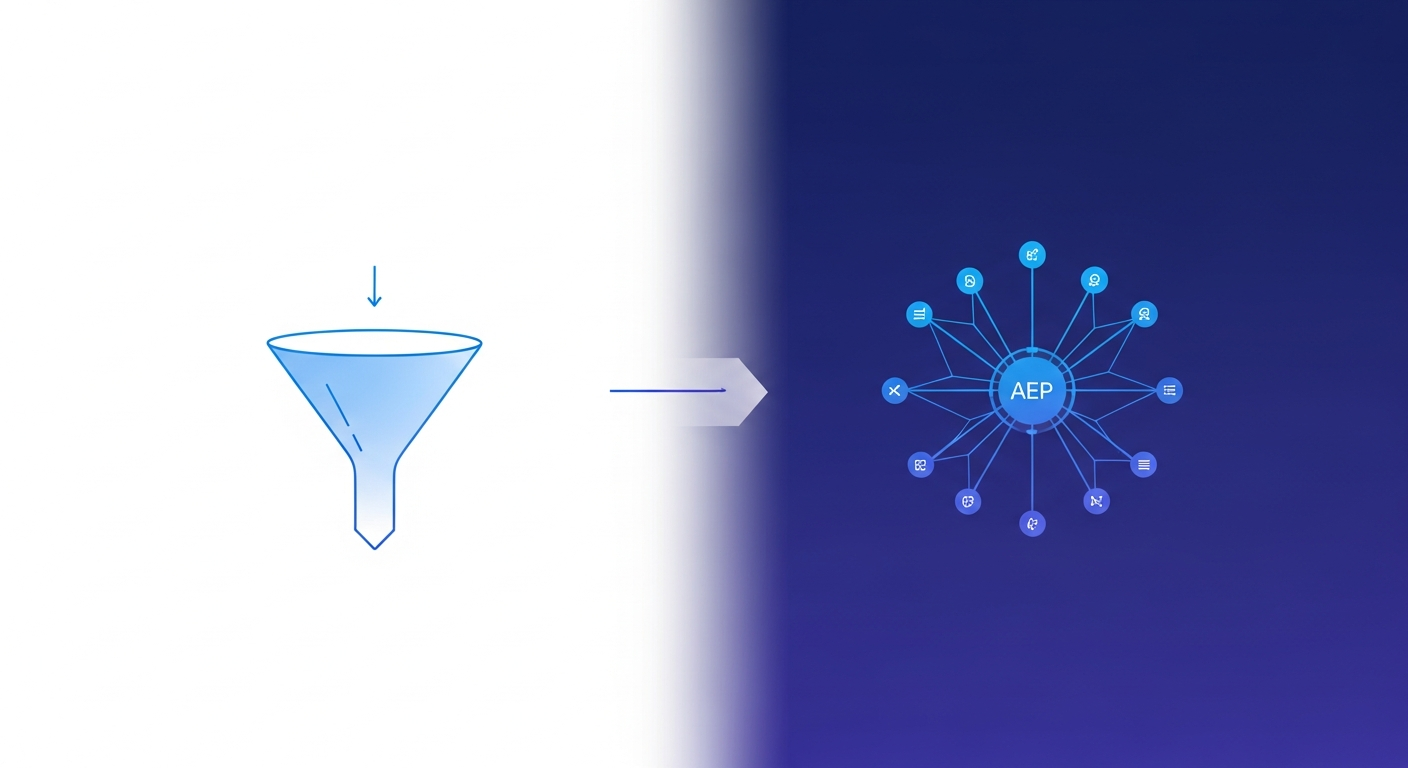
“Funnel Builders” revolutionized digital marketing in 2015.
Russell Brunson with ClickFunnels popularized the idea: create a sequence of pages optimized to convert a visitor into a customer.
Opt-in page → Sales page → Order page → Thank you page.
Simple. Effective. Revolutionary for its time.
But these tools have a major flaw: they are static.
A classic funnel is a rigid pipe. If the customer doesn’t fit the box, they’re lost.
The era of static funnels is over.
Welcome to the era of Dynamic Funnels (Liquid Funnels).
The Problem with Static Funnels
How a Classic Funnel Works
A ClickFunnels or Systeme.io funnel works like this:
- Same entry for everyone: All visitors see the same landing page
- Same path for everyone: Everyone follows the same journey
- Same message for everyone: The same copy, the same arguments
- Same offer for everyone: The same price, the same bonuses
It’s a “one-size-fits-all” approach.
Why It Was Acceptable Before
Before AI, this approach was the best possible compromise.
Creating personalized paths required:
- Developers (expensive)
- Months of work (slow)
- Complex maintenance (fragile)
Better to have a single well-optimized funnel than dozens of poorly maintained variations.
Why It’s Insufficient Now
The fundamental problem: your visitors are not identical.
A beginner and an expert don’t have the same needs. A rushed visitor and a researching visitor don’t behave the same way. A potential $100 customer and a potential $10,000 customer don’t want the same thing.
Forcing everyone into the same funnel is losing conversions.
The Hidden Losses of Static Funnels
Let’s analyze what really happens in a classic funnel.
Loss 1: Wrong Level of Detail
Your sales page is written for a certain sophistication level.
If the visitor is more advanced:
- They find the content basic
- They get bored
- They leave to find something more advanced
If the visitor is less advanced:
- They don’t understand the jargon
- They feel overwhelmed
- They leave to find something simpler
You lose on both sides.
Loss 2: Wrong Timing
Your funnel assumes a certain visitor mindset.
If the visitor is in “research” mode:
- They want information, not an offer
- Your aggressive sales page repels them
- They leave and never come back
If the visitor is in “buy” mode:
- They want to buy now
- Your 10 “nurturing” pages irritate them
- They go buy elsewhere
Loss 3: Wrong Offer
Your funnel proposes a single offer.
If the visitor has little budget:
- Your $997 offer is out of reach
- There’s no cheaper alternative
- You lose the sale AND the contact
If the visitor has lots of budget:
- Your $97 offer seems “not serious”
- There’s no premium option
- You under-monetize the customer
Quantifying the Losses
Out of 1000 visitors to a typical static funnel:
- 20-50 buy (2-5% conversion)
- 950-980 leave without buying
Among those 950-980 who leave, how many would have bought with:
- A message adapted to their level?
- Timing adapted to their intent?
- An offer adapted to their budget?
Probably 10-30% more. That’s huge.
The Dynamic Funnel Revolution
An AEP (Architectural Economic Platform) enables creating Dynamic Funnels — also called “Liquid Funnels”.
The Liquid Funnel Concept
A Liquid Funnel is not a rigid pipe. It’s a river that adapts.
Water (the visitor) naturally finds its way to the sea (conversion).
It goes around obstacles. It adapts to terrain. It never forces against a wall.
How It Works Technically
Step 1: Visitor Analysis
Upon arrival, AI collects signals:
- Traffic source (where do they come from?)
- Navigation behavior (how do they behave?)
- Demographic data (device, location)
- History if available (returned? existing customer?)
Step 2: Real-time Segmentation
AI classifies the visitor into a segment:
- Sophistication level (beginner, intermediate, expert)
- Intent (research, comparison, purchase)
- Probable budget (indirect signals)
- Urgency (casual browsing vs immediate need)
Step 3: Adapted Generation
AI dynamically generates or selects:
- Page content (adapted detail level)
- Copy tone (educational, persuasive, technical)
- Presented offer (price, bonuses, guarantees)
- Next path (nurturing vs direct sale)
Step 4: Continuous Adaptation
With each interaction, AI adjusts:
- If visitor scrolls fast → shorter content
- If visitor reads everything → more detailed content
- If visitor hesitates on price → payment plan offer
- If visitor leaves → personalized exit popup
The Concrete Difference: Static vs Liquid
Example: A Beginner Visitor
Static Funnel (ClickFunnels):
- Sees the same page as everyone
- Doesn’t understand 50% of vocabulary
- Feels “not good enough”
- Leaves after 30 seconds
Liquid Funnel (AEP):
- AI detects their level (little time on site, generalist sources)
- Generates a page with simple vocabulary
- Adds more basic explanations
- Proposes an accessible entry offer
- Converts at 3x higher rate
Example: An Expert Visitor
Static Funnel (ClickFunnels):
- Sees the same basic page as beginners
- Finds content too elementary
- Thinks “this isn’t for me”
- Leaves to find a “pro” solution
Liquid Funnel (AEP):
- AI detects their level (navigation history, technical sources)
- Generates a page with advanced vocabulary
- Removes basic explanations
- Highlights technical features
- Proposes the premium offer directly
- Converts with 5x higher average cart
Example: A Visitor in “Research” Mode
Static Funnel (ClickFunnels):
- Lands directly on an aggressive sales page
- Feels “attacked” when they just wanted information
- Associates the brand with spam
- Never comes back
Liquid Funnel (AEP):
- AI detects intent (exploratory navigation, no urgency signals)
- Presents valuable educational content first
- Captures email with a free resource
- Progressively nurtures via email
- Presents the offer when visitor is ready
- Converts weeks later with a more loyal customer
Measurable Results
Liquid funnels produce radically different results.
Typical Metrics
| Metric | Static Funnel | Liquid Funnel | Improvement |
|---|---|---|---|
| Conversion rate | 2-5% | 5-12% | +150-200% |
| Average cart | Fixed | Variable (adapted) | +30-80% |
| Bounce rate | 60-80% | 30-50% | -40% |
| Time on site | 1-2 min | 3-7 min | +200% |
| Customer satisfaction | Variable | High | +50% NPS |
ROI of the Transition
Imagine a funnel with 10,000 visitors/month:
Static Funnel:
- 300 conversions (3%)
- Average cart: $200
- Revenue: $60,000/month
Liquid Funnel:
- 700 conversions (7%)
- Average cart: $280 (adapted offers)
- Revenue: $196,000/month
Difference: +$136,000/month
That’s the cost of staying on obsolete tools.
Why ClickFunnels Can’t Do This
Structural Limitations
ClickFunnels, Systeme.io, and other classic funnel builders have fundamental limitations:
Rigid architecture
- Designed for static pages
- No native dynamic generation
- Personalization limited to simple rules
No integrated AI
- No real-time behavioral analysis
- No content generation
- No continuous adaptation
Obsolete business model
- They sell simplicity
- Adding complexity would go against their positioning
- Their user base isn’t ready for this
Adaptation Attempts
These tools add “AI” features:
- Basic copy generation
- Automated A/B testing
- Some personalization
But it’s makeup on a fundamentally static system.
It’s not liquid architecture. It’s slightly flexible static.
Migration to Liquid Funnels
How to go from a static funnel to a liquid funnel?
Step 1: Audit Your Current Funnel
Analyze your data:
- Where are the leak points?
- Which segments convert best?
- Which visitors leave immediately?
Step 2: Identify Segments
Define 3-5 visitor segments:
- Beginners vs Experts
- Rushed vs Researchers
- Limited budget vs High budget
Step 3: Create Variations
For each segment, define:
- The adapted message
- The adapted offer
- The adapted path
Step 4: Implement in the AEP
Configure your AEP to:
- Detect segments
- Generate adapted content
- Route to the right path
Step 5: Continuous Optimization
AI learns and improves:
- Refining segmentation rules
- Testing new variations
- Optimizing thresholds
Conclusion
Sales funnels were a revolution.
But like any revolution, it’s overtaken by the next one.
Don’t force your customers into a concrete pipe.
Offer them a river that adapts to them.
Static funnels convert visitors who match your ideal case. Liquid funnels convert all visitors by adapting to each one.
It’s the difference between a salesperson who recites their script and a salesperson who listens and adapts.
The era of rigid funnels is over.
Welcome to the era of Liquid Funnels.